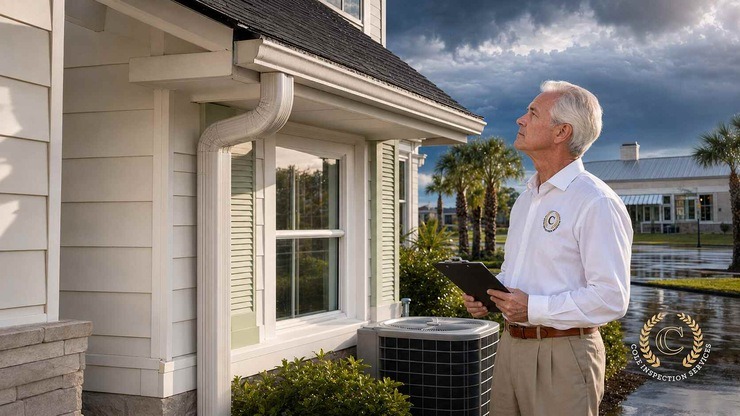
Your Property Is Being Stress-Tested Right Now: 7 Hidden Problems Gulf Coast Heat, Humidity and Storms Can Expose
A late-summer inspection can uncover small warning signs before they become expensive repairs, failed transactions, insurance complications or major disruptions.
Along Florida’s Emerald Coast, August is not an ordinary month for a building.
Roofs endure relentless sun and sudden downpours. Air-conditioning systems operate almost nonstop. Humid air searches for every opening it can find. Wind-driven rain tests flashing, windows, doors and exterior walls. Meanwhile, drains, electrical components and plumbing systems continue aging behind finished surfaces.
Your home or commercial property is being stress-tested—and some of the most expensive problems may remain invisible until significant damage has already occurred.
That makes late summer one of the most revealing times to schedule a professional property inspection.
A “Quieter” Hurricane Forecast Is Not an All-Clear
NOAA’s updated 2026 outlook favors a below-normal Atlantic hurricane season. That sounds reassuring, but it does not mean Northwest Florida is protected from a damaging storm.
It only takes one system passing through the wrong location to cause serious wind and water damage. Historically, Atlantic hurricane activity peaks around September 10, with most activity occurring between mid-August and mid-October.
Even without a named storm, ordinary Gulf Coast weather can reveal weaknesses in a building. Repeated heat, humidity and heavy rain can turn a minor defect into an expensive problem.
Here are seven warning signs property owners, buyers, sellers and investors should not ignore.
1. A Roof That Looks Fine From the Ground
A roof does not need to be actively leaking into a room to have a problem.
Heat, ultraviolet exposure, wind and rain can contribute to damaged or lifted shingles, deteriorated sealants, loose flashing, exposed fasteners and vulnerable roof penetrations. Water may enter through a small opening and travel along decking or framing before becoming visible inside.
By the time a ceiling stain appears, moisture may already have affected insulation, sheathing or nearby building materials.
Cole Inspection Services uses professional inspection methods and specialized equipment, including a camera mounted on a telescoping pole and a drone when needed, to evaluate areas that may be difficult to see safely from the ground.
2. Moisture Hiding Behind a Clean Wall
Fresh paint can improve a room’s appearance, but it cannot correct the source of hidden moisture.
Water intrusion may originate around windows, doors, roof penetrations, plumbing fixtures, exterior walls or poorly sealed transitions. In humid coastal conditions, damp materials may not dry quickly enough to prevent deterioration or conditions favorable to mold growth.
Possible warning signs include:
- Musty or earthy odors
- Peeling or bubbling paint
- Discoloration near ceilings or baseboards
- Warped flooring
- Condensation in unexpected areas
- Rooms that consistently feel damp
- Previous leaks that were repaired cosmetically but never evaluated
Cole Inspection Services can use moisture meters and infrared thermal imaging to identify temperature patterns and elevated moisture readings that deserve closer investigation. Thermal imaging does not see through walls, but it can help reveal clues that may otherwise go unnoticed.
When mold is suspected, a professional mold assessment can help determine whether additional testing or corrective action is appropriate.
3. An Air Conditioner Losing the Battle
An HVAC system may continue producing cool air while operating inefficiently or showing early signs of trouble.
During a Northwest Florida summer, the system must control both temperature and indoor humidity. Restricted airflow, dirty components, drainage problems, damaged ductwork, poor insulation or aging equipment can reduce performance and contribute to uncomfortable rooms, excessive moisture and higher operating costs.
Warning signs can include:
- Uneven temperatures
- Unusually long cooling cycles
- Water near the indoor unit
- Rust or corrosion around equipment
- Weak airflow from registers
- Condensation around ducts or vents
- Indoor humidity that remains persistently high
A property inspection is not a substitute for specialized HVAC servicing, but it can identify visible defects, performance concerns and conditions that should be evaluated by a qualified contractor.
4. Drainage That Sends Water Toward the Building
Some of the most important storm protection features are not inside the home or business. They are found in the way water moves across the property.
Improper grading, clogged gutters, short downspouts, soil settlement and poorly directed roof runoff can allow water to collect near the foundation or exterior walls. Over time, recurring moisture can contribute to erosion, wood deterioration, pest activity and water intrusion.
Commercial properties face additional concerns. Ponding near entrances, sidewalks or parking areas can create maintenance problems and potential safety hazards for employees, tenants and customers.
The best time to discover where water goes is before the next major downpour—not after it enters the building.
5. Electrical Problems Under Heavy Demand
Hot weather places sustained demand on electrical and mechanical systems. Air conditioners, pool equipment, appliances, commercial refrigeration and other equipment may operate for extended periods.
An inspection may identify visible concerns such as:
- Improper wiring
- Double-tapped breakers
- Damaged electrical components
- Missing safety protection
- Corrosion
- Overheating indicators
- Unsafe modifications
- Equipment installed without appropriate clearance or protection
Electrical defects deserve prompt attention. When an inspector identifies a concern, further evaluation and repairs should be completed by a properly qualified electrician.
6. Four Major Systems That Can Affect Insurability
In Florida, an insurance company may request a Four-Point Inspection, particularly for an older home. This inspection focuses on four major systems:
- Roofing
- Electrical
- Plumbing
- Heating, ventilation and air conditioning
A Four-Point Inspection is not the same as a comprehensive home inspection. Its primary purpose is to document the visible condition and age of these systems for insurance underwriting.
A Wind Mitigation Inspection serves a different purpose. It documents eligible construction features designed to reduce wind damage, such as roof geometry, roof-to-wall connections, roof-deck attachment and opening protection.
Florida requires residential property insurers to offer applicable discounts for qualifying hurricane-loss mitigation features. However, the amount of any credit depends on the documented features, the property and the insurance carrier.
Florida also introduced an updated Uniform Mitigation Verification Inspection Form effective April 1, 2026. A completed form can remain valid for up to five years when no material changes or inaccuracies are present.
Property owners should discuss their individual requirements and potential credits with their insurance agent. An inspection documents qualifying conditions; it does not guarantee coverage, eligibility or a particular premium reduction.
7. Deferred Maintenance in a Commercial Property
A commercial building can appear profitable on paper while carrying significant deferred-maintenance exposure.
Before purchasing, leasing or managing an office, retail location, warehouse, industrial property, strip center or standalone building, decision-makers need a clearer understanding of the physical asset.
A commercial inspection can help identify visible concerns involving:
- Roofing and exterior components
- Electrical and plumbing systems
- Heating and cooling equipment
- Interior conditions
- Moisture intrusion
- Safety-related observations
- Deferred maintenance
- Areas requiring specialist evaluation
For investors and business owners, this information can influence negotiations, improvement budgets, reserve planning and the overall feasibility of a purchase or lease.
A building inspection cannot predict every future failure, but it can replace assumptions with better information.
Buyers: Do Not Let a Beautiful Property Rush Your Decision
Florida’s real estate market continues to shift, but some buyers still waive inspection contingencies to make their offers more competitive. Recent National Association of Realtors data indicates that approximately 20% of buyers waived an inspection contingency.
That decision can carry additional risk along the Gulf Coast, where attractive finishes may conceal roof, moisture, HVAC, plumbing or electrical concerns.
An inspection is not about finding a “perfect” property. Very few properties are perfect. It is about understanding what you are purchasing before the inspection period ends.
A detailed report can help you:
- Prioritize significant findings
- Ask better questions
- Plan future maintenance
- Obtain specialist opinions when necessary
- Discuss repairs or other options with your real estate professional
- Move forward with greater confidence
Sellers: Find the Surprise Before Your Buyer Does
A pre-sale inspection gives property owners an opportunity to discover visible concerns before listing.
That additional time can help sellers obtain estimates, complete selected repairs, gather documentation and price the property with a clearer understanding of its condition. It may also reduce the likelihood of last-minute surprises after a buyer’s inspection.
A pre-listing inspection does not guarantee a problem-free transaction, but preparation can place a seller in a stronger and more transparent position.
New Construction Needs an Independent Inspection Too
A newly built home can still contain incomplete work, installation defects or components that need correction.
Municipal code inspections serve an important purpose, but they are not the same as an independent inspection performed for the buyer. A new-construction inspection provides another opportunity to document visible concerns before closing or before applicable builder warranty periods expire.
New does not automatically mean flawless. It means the buyer has a valuable window in which to verify the condition of the property.
One Inspection Can Change the Next Decision
The most expensive property problem is often the one nobody knew to investigate.
A professional inspection cannot eliminate every risk, open walls or guarantee future performance. What it can provide is an experienced, independent evaluation of visible and accessible conditions, supported by detailed reporting and modern inspection tools.
Cole Inspection Services provides:
- Residential home inspections
- Commercial property inspections
- Wind Mitigation Inspections
- Four-Point Inspections
- Mold inspections and assessments
- New-construction inspections
- Pre-sale inspections
- Thermal imaging
- Insurance-related property inspections
Cole Inspection Services serves Destin, Santa Rosa Beach, Miramar Beach, Alys Beach, WaterColor, Seaside, Rosemary Beach, Inlet Beach, Seacrest, Panama City Beach, Navarre, Gulf Breeze and surrounding communities across Northwest Florida.
Lead inspector Wayne Cole is a Certified Master Inspector with more than 40 years of experience working with homes, including over 30 years in Florida. Cole Inspection Services provides thorough, objective inspections and explains the findings clearly so clients can make informed decisions.
Do Not Wait for a Leak, Failed Closing or Insurance Deadline
Whether you are buying a coastal home, preparing to sell, evaluating an investment property, renewing insurance or responsible for a commercial building, knowing the property’s condition is one of the smartest ways to protect your next decision.
Schedule your inspection with Cole Inspection Services online or call (850) 910-1113.
Santa Rosa Beach Home Inspector
Florida Licensed Home Inspector #HI963
Florida Licensed Mold Assessor #MRSA2612